
Logging in (first time)
The first time you access your website, you will need to authenticate through Azure/Entra.
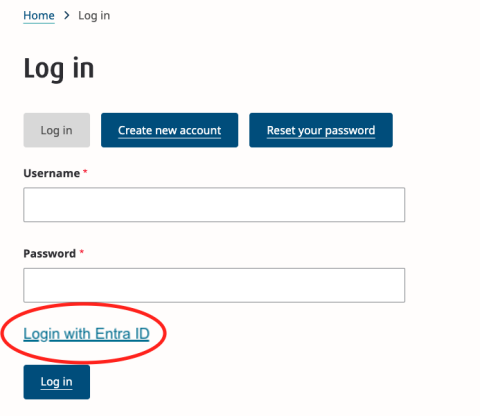
You will then be granted access to the back end of the website without a specific role applied to your user. After you have authenticated the first time an administrator can assign you your role. Once that has been done you can refresh your screen and you will see the CMS toolbar and have access to everything included with your assigned role.
How to add a user
- Log in to your Drupal site as an administrator.
- Click on the "People" link in the Drupal Admin menu near the top of your browser.
- You will see a list of people who have authenticated, but do not yet have roles assigned.
- Click the "Edit" button next to the user you wish to assign a role for.
- Use the checkbox(es) provided to assign the appropriate role(s). Note that more than one role can be assigned to a user.
- Click "Save".
Note: Filling out the user's information in the form including edits to username, email address, and password for the user will not take effect as these details are passed directly to Drupal from Azure/Entra. All password and user detail management must happen in CRD's Azure/Entra environment.
Defining user roles
Choose the user's role from the "Roles" field. Roles define the permissions and access levels that the user will have on the site. For example, you can assign the user to the "Content Publisher" role to give them permission to edit content on the site.
Setting the user status
You can also change the status for a user as either "Active" or "Blocked." Drupal will default to "Active" to ensure the user has access to the site. If a user's status is set to "Blocked", they will not be able to log into the site.
Available roles
The following roles are available:
- Administrator role
- Full access to all areas of the site for IT-level users
- Intended for one or two users who are experienced with CMS application management and familiar with application security.
- Content - Admin role
- Access to all publishing requirements of the site.
- Access to management tools for media, theme menus, webforms and taxonomy vocabularies
- Will not be restricted by having limited access to certain content authoring tools
- Will moderate and approve Page content edits submitted for review
- Content - Publisher role
- Access to all publishing requirements on all content types.
- Access to management tools for media
- Access to manage the main menu
- No access to webforms and taxonomy vocabularies
- Will moderate and approve Page content edits submitted for review
- Content - Editor role
- Will be able to create drafts of existing nodes and submit them for review to Content – Admins and Content - Publishers.
- Content - Viewer role
- Will be able to view drafts of existing nodes only.
- No access to content authoring at all, intended for previewing drafts only.
- Additional per-user Access roles
- While each user is assigned into one of the above “Content” roles, additional access can be granted on a per-user basis using the following Access roles (not exhaustive):
- Access – Cache Rebuild
- Access – Dark Site
- Access – Menus
- Access – Security
- Access – Taxonomies
- Access – Users
- Access – Webforms
- While each user is assigned into one of the above “Content” roles, additional access can be granted on a per-user basis using the following Access roles (not exhaustive):